Your legal duties, and who is responsible
Module 2 of 8 · about 8 minutes
Module 2 of 8 · sScreen 1 of 12 · about 8 minutes
In this module
By the end you will be able to:
- Say who is responsible for legionella in your building
- Name the five duties the HSE lists
- Explain what a responsible person does, and what a contractor does not take off you

A managing agent runs the building, a contractor does the water checks, and the company rents the space. Who is responsible for legionella?
What an assessor sees
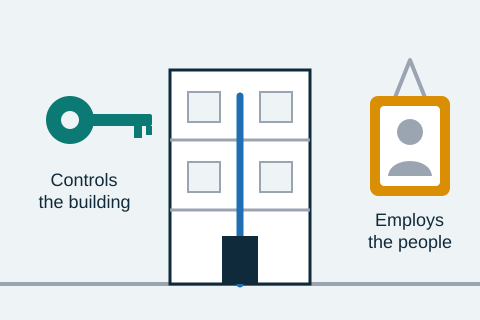
Whoever controls the premises, and the employer of the people in it. That can be more than one organisation at once. A contractor doing the checks does not take the duty off either of them.
Who carries the duty
The HSE puts it in one sentence: as an employer, or someone in control of premises, you are responsible for health and safety. Legionella is part of that.
So the duty sits with the employer and with whoever controls the building: an owner, a landlord, a managing agent, a facilities team. In a shared building, more than one of them.
Two more duties come with it: telling your local authority in writing if the site has a cooling tower or evaporative condenser, and reporting to the HSE, under RIDDOR (the regulations for reporting injuries, diseases and dangerous occurrences at work), a case of Legionnaires' disease in a worker who worked on a water system likely to carry legionella.
Where the duty comes from
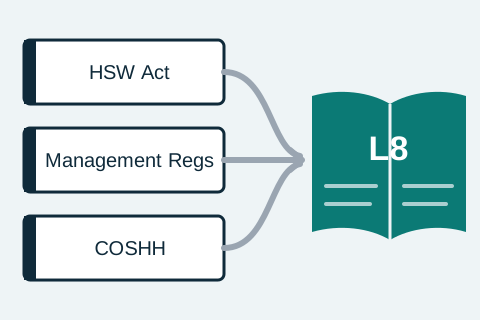
Three pieces of law: the Health and Safety at Work Act, the Management of Health and Safety at Work Regulations and COSHH, which treats legionella as a hazardous substance.
None of them says the word legionella. The HSE's Approved Code of Practice L8 does: it says how to meet those duties for water systems. Follow it and you are taken to have complied; do something else and you must show it was as good.
This is the law of Great Britain: England, Scotland and Wales alike. Northern Ireland has the same duties under its own regulations and its own executive, HSENI. Wherever in the UK your building is, the duty and the guidance read the same.
Quick question
What the HSE says you must do
Five duties. The rest of this course is how to meet them.
The HSE’s words · 1 of 4
You must identify and assess the sources of risk, manage them, prevent or control them, keep the right records, and carry out any other duties you have.
You must appoint someone competent to help you: the responsible person, who may be you, a member of staff or someone from outside.
A cooling tower or evaporative condenser must be notified to the local authority in writing, and again when it stops being used.
A case of legionellosis in an employee who has worked on a cooling tower or a water system likely to be contaminated must be reported under RIDDOR.
The responsible person, and contractors
You must appoint someone competent to help: the responsible person. It may be you, a member of staff, or someone from outside. They need enough authority and knowledge of the building to make sure the checks happen.
A water treatment company can do the work. The HSE is clear that it is still the responsibility of the competent person to make sure it is done to the standard required. You check your contractor; nobody checks for you.

Quick question
In your building
For something else, or i just want to understand it.
Work out who controls the water system and who employs the people in the building; the duty sits with them, together. Then name a responsible person in writing.
This week: write down who controls the water system, who employs the people, and who the responsible person is.
In short
- The duty sits with the employer and whoever controls the building, together.
- It comes from the Health and Safety at Work Act, the Management Regulations and COSHH; ACOP L8 says how to meet it.
- Five duties: identify and assess the risk, manage it, prevent or control it, keep records, and meet any other duties.
- Appoint a responsible person. A contractor does the work; the responsibility stays yours.
Before you go · question 1 of 3 · not marked
Module 2 of 8 done
Next: Module 3, How water moves round a building.
Save and carry on later: this browser remembers where you are.
Sources
- HSE: Legionnaires' disease, what you must do
- HSE: Managing the risk
- HSE: Duties under other regulations
- ACOP L8 (HSE, 2013)
Words last checked 17 October 2026. Spotted a mistake? Tell us. Course version 2026.10.