Tell a calorifier from a combination boiler, and a loop from a dead leg
Say where in that journey legionella gets its chance
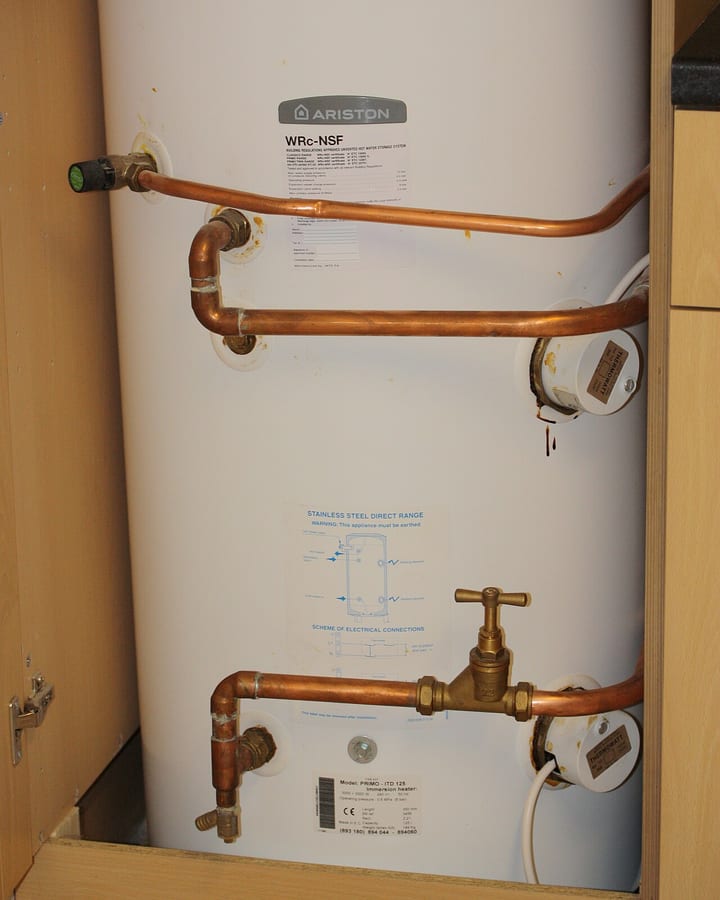
A hot water cylinder; in larger buildings, a bigger one called a calorifier. This one is heated by electric immersion heaters, top and bottom; a calorifier is usually heated by a coil. Photo: Julie Anne Workman, CC BY-SA 3.0, cropped.
This cylinder is set to 60 °C. Where in it could water still be lukewarm?
What an assessor sees
At the bottom. Cold water feeds in low down, sediment collects there, and the base can sit well below the temperature at the top. HSG274 names the base of the storage vessel as a place to look.
From the mains to the tap
Water arrives from the mains, cold and clean, through a stop valve. Some taps are fed straight from the mains. Others are fed from a cold water storage tank, usually in a roof space or plant room.
Hot water comes from a calorifier (a cylinder heated by a coil), a direct-fired heater, or a combination boiler that heats water as it passes and stores none. Each gives legionella a different chance.
Loops, branches and dead legs
In a large building hot water goes round a circulating loop: a flow pipe out, a return pipe back, kept moving by a pump so hot water is never far from any tap.
Off the loop run branches to single outlets. A branch to a tap nobody uses is a dead leg: the HSE's words, a pipe leading to an outlet which water flows through but the outlet is unused or rarely used. A capped-off pipe is a dead end. Both hold still water.
Quick question
The temperatures the system is built around
Legionella grows between 20 and 45 °C, so the system is designed to keep water out of that band.
The HSE’s words · 1 of 2
Hot water is stored at 60 °C or more and reaches 50 °C at the tap within one minute (55 °C in healthcare).
Cold water is kept below 20 °C, and should be there within two minutes of running the tap.
Mixing valves, and where the risk sits
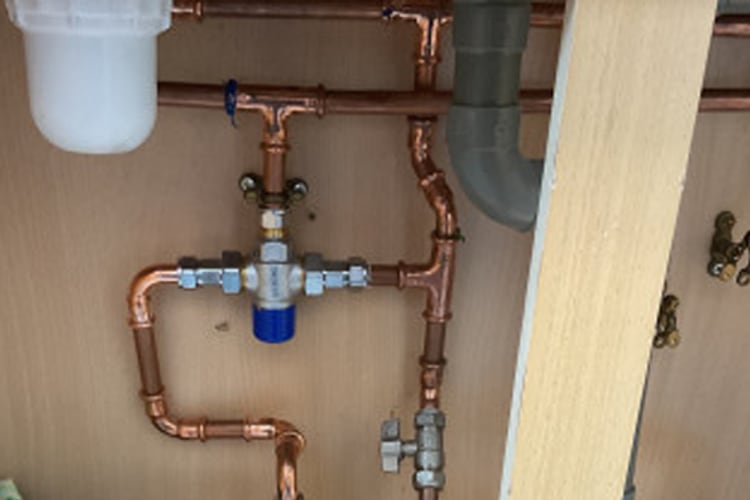
Hot water at 60 °C scalds. Where people at risk use a tap, a thermostatic mixing valve blends hot and cold just before the outlet; a Type 3 valve must stop water above 44 °C. The blended pipe after it is lukewarm by design, so it is kept short.
Put the journey together and the risk sits in the same few places: the base of the cylinder, dead legs and capped pipes, outlets that are rarely used, and cold pipes that run warm because they pass near heat.
Two pipes in, one out: a mixing valve.
Quick question
In your building
For something else, or i just want to understand it.
Find out which of these your building has: a tank or mains only; a calorifier, heaters or a combination boiler; a circulating loop or single branches; mixing valves. That is the start of your schematic: a simple drawing of the pipes, tanks and heaters.
This week: sketch where the water comes in, where it is stored or heated, and where it goes.
In short
Water comes from the mains, is sometimes stored in a tank, and is heated in a calorifier, a heater or a combination boiler.
Hot water is stored at 60 °C or more and reaches 50 °C at the tap within a minute (55 °C in healthcare); a cold tap should be below 20 °C within two minutes of running.
Loops keep hot water moving; branches to unused outlets are dead legs where water stands.
Mixing valves stop scalding and leave a short lukewarm pipe by design.