Example Legionella Risk Assessment Report
This is what a legionella risk assessment report covers, shown for a made-up dental practice. A one-page summary, an action plan with dates, a schematic, an asset register, the temperatures taken, a record of every outlet, risk scores, photographs, and the limits of the assessment.
The site, the people, the readings and the photographs are illustrative. They do not belong to any real building. The PDF is free to download, with no sign-up.
Download the sample report (PDF, 18 pages)
Want one for your own site? A fixed price within one working day.
What the sample shows
The sample is an 18-page report for Example Dental Practice: a converted house with three surgeries, a cold water tank in the loft, a hot water cylinder, four mixing valves and three dental chairs. Every reading, date and name in it is made up.
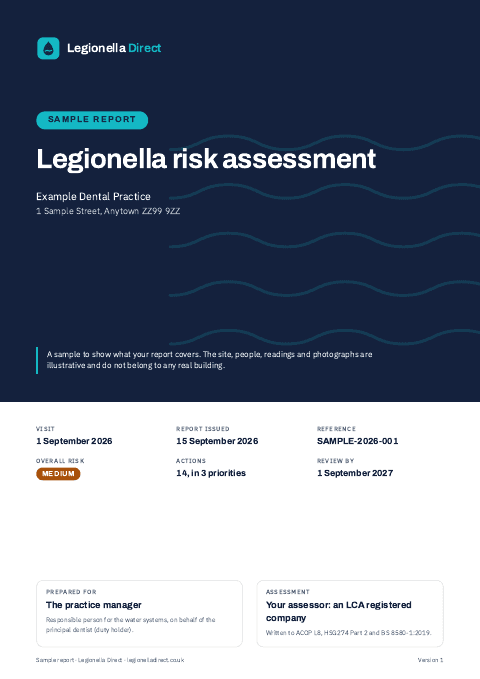
The cover. The site, the dates, the overall risk and who the report is for, marked as a sample. 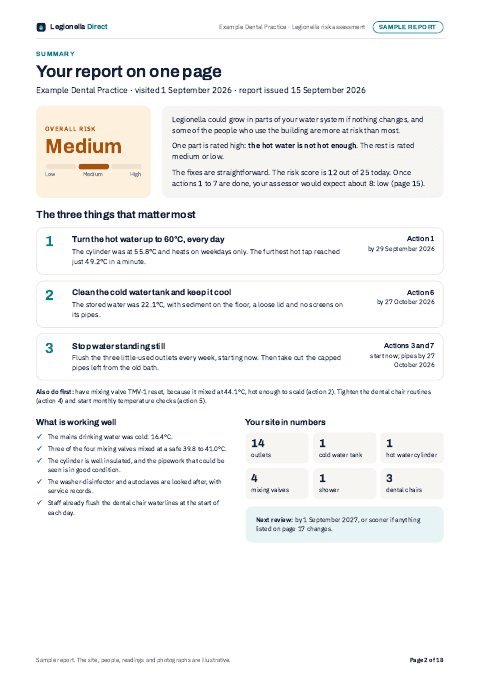
Your report on one page. The overall risk in words and as a score, the three things that matter most, and what is working well. 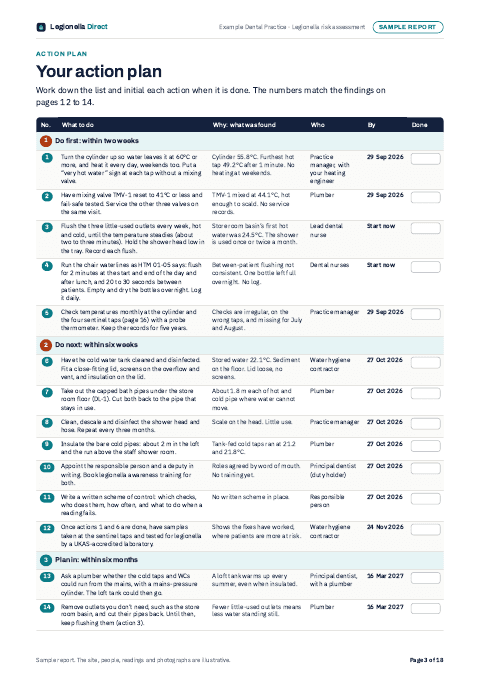
The action plan. Every action numbered, with its priority, who does it, a date, and a box to tick off. 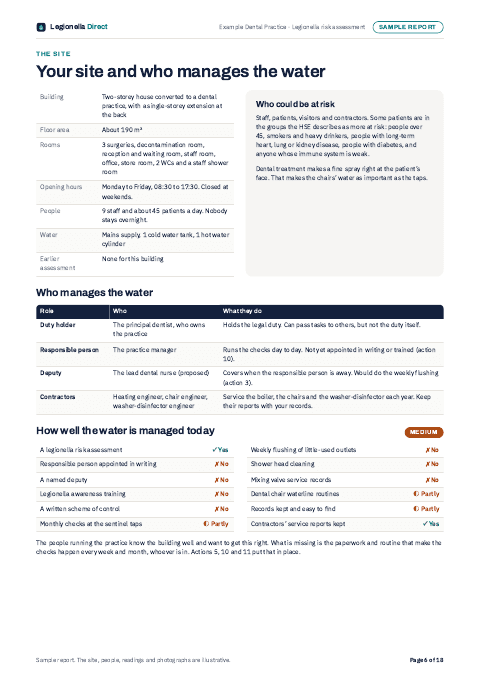
Who manages the water. The duty holder, the responsible person, and a check of how well the controls run today. 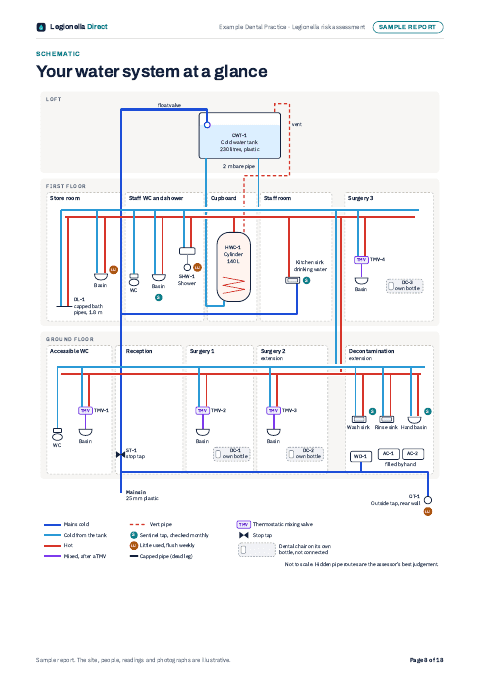
The schematic. How water gets from the mains to every outlet, with each tank, cylinder and valve numbered. 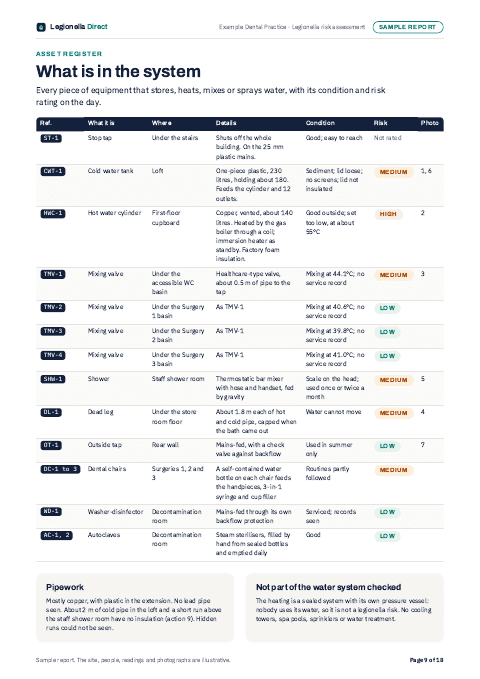
The asset register. Every tank, cylinder, mixing valve and shower, with its condition and risk rating. 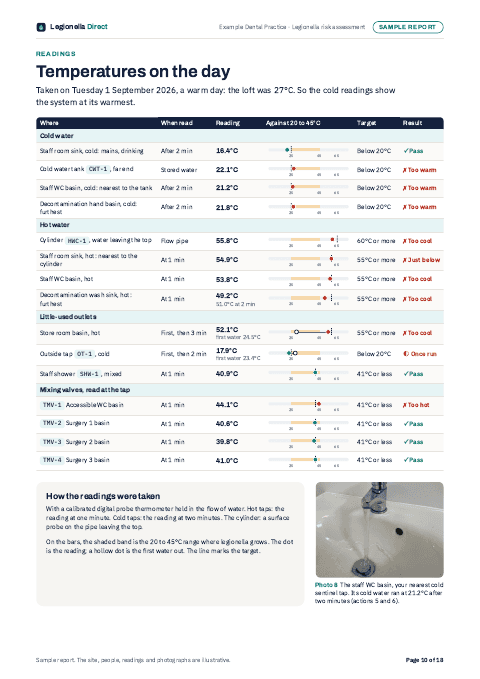
Temperatures on the day. Every reading against its target, with a pass or a fail you can see at a glance. 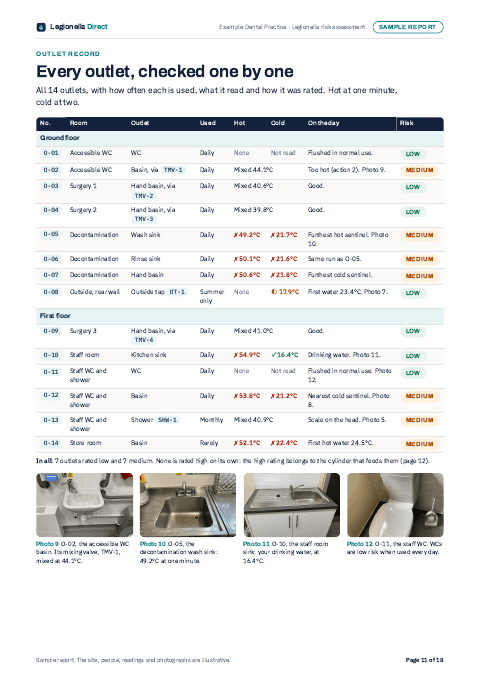
Every outlet, checked. All 14 outlets: how often each is used, its hot and cold readings, and its risk. 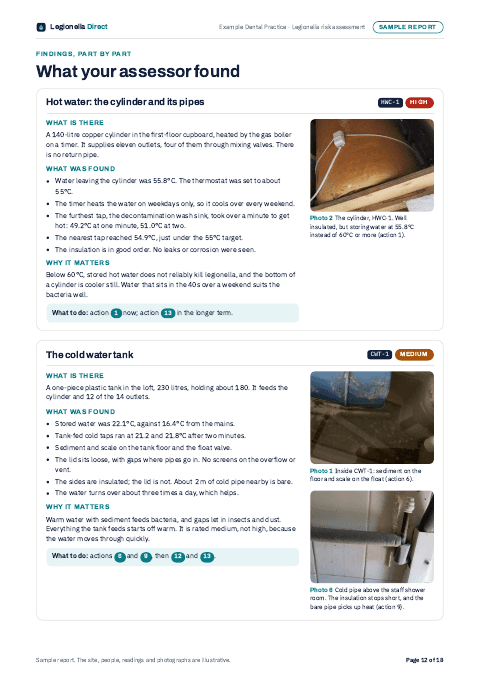
What the assessor found. Each part of the system rated, with photographs and the actions that fix it. 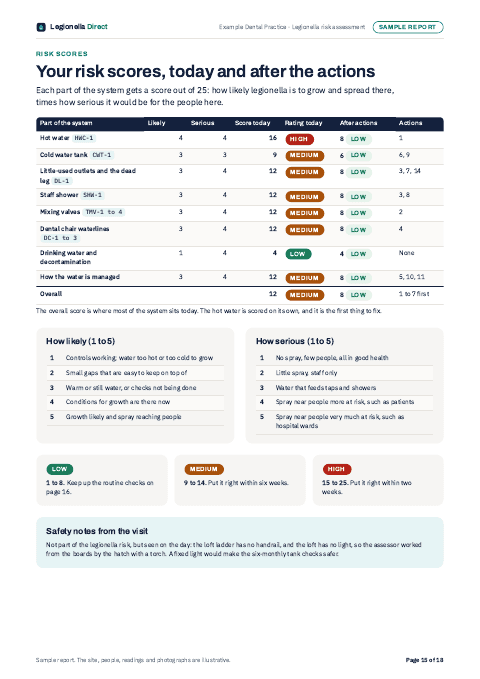
Risk scores. Each part scored out of 25 for how likely and how serious, today and after the actions.
What each part of the report tells you
The report starts with what you need to act on, then shows the evidence behind it.
- Your report on one page. The overall risk, explained in words, the three actions that matter most, and what is already working.
- The action plan. Every action numbered and put in one of three priorities, with who does it and a date to do it by.
- About the assessment. Why it was done, what it covered, what it did not, and the HSE guidance and British Standard it follows.
- Your site and who manages the water. Who could be at risk, the duty holder and responsible person, and how well the checks run today.
- How the water system works. A walk from the mains to every outlet, room by room, then a schematic drawing of the same thing.
- The asset register. Every tank, cylinder, mixing valve, shower and dental chair, with its condition and risk rating.
- Temperatures on the day. Every reading against its target: the tank, the cylinder, the sentinel taps and the mixing valves.
- Every outlet, checked. All 14 taps, sinks, WCs and the shower: how often each is used, what it read, and its risk.
- What the assessor found. Each part of the system: what is there, what was found, why it matters and which actions fix it, with photographs.
- Risk scores. Each part of the system scored out of 25, for how likely legionella is to grow there and how serious it would be, today and once the actions are done.
- Keeping it under control. The routine checks, how often and who does them, and what to do when a reading fails.
- Limits and review. What the assessor could not see, the date to review the assessment, and the changes that would bring it forward.
Risk ratings are high, medium or low, each explained in plain words and backed by a score. Every piece of equipment has a reference, such as TMV-1, used the same way on the schematic, in the register, in the photographs and in the action plan.
City & Guilds qualified, LCA registered assessors · Report usually within 10 to 15 working days of the visit
Your own report
Your report is written by the risk assessor who carries out your assessment, one of our City & Guilds qualified, LCA registered risk assessors. It covers the same things as the sample, though the layout may differ.
It is written to BS 8580-1, the British Standard for legionella risk assessments. The report includes photographs of the plant and anything that needs fixing.
It usually arrives within 10 to 15 working days of the visit. Some reports take longer, if the assessor needs more from you after the visit.
The price covers the visit and the written report, + VAT, and your fixed price arrives by email within one working day.
About 2 minutes · No account · No obligation
Questions people ask
Is this a real legionella risk assessment?
No. It is a sample, made to show what a report covers. The site, the people, the readings and the photographs are illustrative and do not belong to any real building.
Will my report look exactly like this?
Not exactly. Your report is written by the company that carries out your assessment, in its own layout. It covers the same things: the summary, the actions, the schematic, the asset register, the readings, photographs, the limits and a review date.
How long is a legionella risk assessment report?
It depends on the site. This sample runs to 18 pages for a small dental practice with one tank and one cylinder. A bigger site, with more plant and more outlets, has a longer report.
When will I get my report?
Usually within 10 to 15 working days of the visit. Some take longer, if the assessor needs more from you after the visit.
Does the report include photographs?
Yes. Your assessor photographs the plant and anything that needs fixing, where a photograph helps the report.
How is the risk scored in a legionella risk assessment?
Each part of the water system is judged on how likely legionella is to grow and spread there, and how serious that would be for the people in the building. In this sample, each is scored from 1 to 5 and the two are multiplied, giving a score out of 25: low, medium or high. Assessors use different scales, but every report should explain its own.
Does the assessor check every tap?
A good assessment records every outlet: where it is, how often it is used and its condition. Temperatures are taken at the sentinel taps, the nearest and furthest from the tank and cylinder, and at little-used outlets and mixing valves. The sample's outlet record shows all 14 outlets for a small practice.
Can I download the sample report for free?
Yes. The PDF is free, with no sign-up and no email asked for. It is a sample for a made-up site, so it cannot be used as a risk assessment for a real building.
Does the report tell me what to do next?
Yes. It ends in an action plan: what to fix, in what order and by when, and the routine checks to keep doing. Many sites write their written scheme of control from it.
Sources
The sample report is illustrative: the site, people, readings and photographs do not belong to any real building. This page is not legal advice.
Related
Your fixed price. Six questions from here.
Carried out by our City & Guilds qualified, LCA registered risk assessors.