Where the risk is
Module 4 of 8 · about 8 minutes
Module 4 of 8 · sScreen 1 of 12 · about 8 minutes
In this module
By the end you will be able to:
- Name the four conditions legionella needs, and spot where they meet
- Walk a building and point to its everyday risk points
- Recognise the specialist kit that needs its own controls
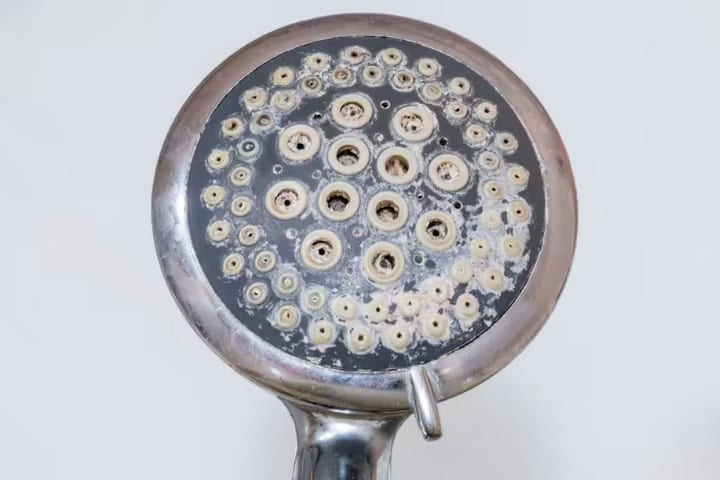
This shower is used once a month, by whoever is on the late shift. Why is it the riskiest outlet in the building?
What an assessor sees
All four conditions meet in it: the water stands in the pipe between uses, it sits at room temperature, the scale on the head feeds the bacteria, and the fourth, a fine spray breathed in, is what a shower is for. A shower used once a month belongs on the weekly flushing list.
The four conditions
Legionella needs four things to become a danger: warmth between 20 and 45 °C; water that stands or goes round again; food, meaning rust, sludge, scale and biofilm (the slimy film that builds up inside pipes and hoses); and a way of making a breathable spray. Take one away and the risk drops. Take the spray away and nobody can breathe it in.
Nearly every risk point on the next screen is a place where two or three of these meet. The job of the controls in later modules is to break the chain: keep the water cold or hot, keep it moving, keep it clean.
The everyday risk points
In most buildings the risk sits in ordinary places: outlets rarely used (a spare toilet, a cleaner's sink, a shower in an empty flat); showers and spray taps, which make the droplets; the base of a hot water cylinder; a cold water tank in a warm roof space; and dead legs left when a room was changed.
Add the small things: flexible hoses under basins, which the HSE names as a fitting that can raise the risk; the lukewarm pipe after a mixing valve; electric showers and small heaters set to warm; a garden hose on a sunny wall; a humidifier topped up by hand.
Quick question
The systems the HSE tells you to look at
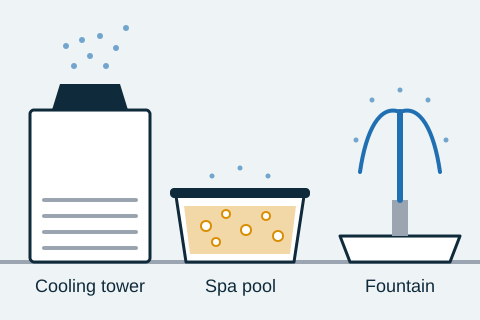
The assessment starts from a list, and the list is short. Most buildings have hot and cold water; some also have a cooling tower or a spa pool.
The HSE’s words · 1 of 3
The HSE names evaporative cooling systems, hot and cold water systems and spa pools, and says to look at the equipment on them too: pumps, heat exchangers, showers and their parts.
Risk collects where water stands or stays warm: the base of a hot water cylinder, dead legs and capped pipes, outlets that are rarely used, and cold pipes that pick up heat.
Risk is controlled by keeping the system and the water in it clean and free of the deposits bacteria feed on, including scale, which traps nutrients.
The specialist kit, named once
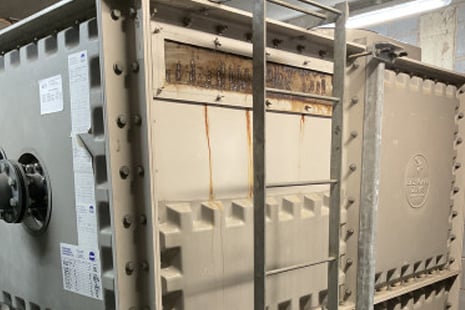
Some equipment creates spray on purpose, or holds warm water by design, and needs controls of its own: cooling towers and evaporative condensers (extra A); spa pools and hot tubs (extra F); dental unit waterlines (extra E); humidifiers and misting systems; vehicle and pressure washers; fountains and water features; emergency showers and eyebaths.
If your building has any of these, the core course still applies, and the extra for it tells you what is different. If it has none, the ordinary hot and cold water system is where your attention goes.
Quick question
In your building
For something else, or i just want to understand it.
Walk your building with the four conditions in mind: where does water stand, where is it warm, where is there scale or dirt, and where is it sprayed? The outlets nobody uses and anything that makes a mist are the places to write down first.
This week: write down the five outlets in your building that are used least.
In short
- Four conditions: warmth between 20 and 45 °C, standing water, food in the form of scale, rust and biofilm, and a breathable spray.
- The everyday risk points are little-used outlets, showers, the base of the cylinder, a warm cold tank, dead legs and flexible hoses.
- Cooling towers, spa pools, dental lines, humidifiers, washers and fountains need controls of their own, in the extras.
Before you go · question 1 of 3 · not marked
Module 4 of 8 done
Next: Module 5, The risk assessment and the written scheme.
Save and carry on later: this browser remembers where you are.
Sources
- HSE: What is Legionnaires' disease?
- HSE: Identify and assess sources of risk
- HSG274 Part 2: hot and cold water systems (HSE, 2014)
Words last checked 17 October 2026. Spotted a mistake? Tell us. Course version 2026.10.