Say what a risk assessment must cover, and who can carry one out
Read your own assessment and know what to do with its findings
Tell the assessment from the written scheme, and know when each is reviewed
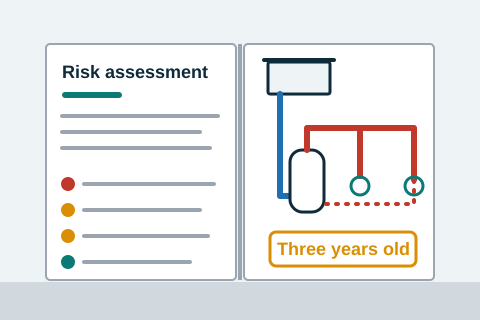
An assessment, three years old.
This assessment is three years old. Is it out of date?
What an assessor sees
Not because of its age. It is out of date if something it describes has changed: a new boiler, a wing closed, a change of use, a check that keeps failing, a case of illness. There is no two-year rule in ACOP L8; the trigger is any reason to doubt it still holds.
What an assessment is
A legionella risk assessment is a competent look at the whole water system against the four conditions, written down. It names the responsible person, describes the system with a schematic drawing, lists the risks found and the controls in place, sets out the checks, and says when it will be reviewed.
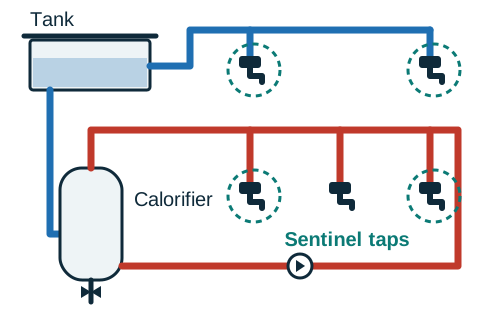
British Standard BS 8580-1:2019 is the code of practice for legionella risk assessments, and the HSE points to it for the detail. A good report is written so that you can act on it: each finding has a priority and a plain action, and the schematic lets anyone follow the water round the building.
The schematic: the one page an assessor turns to first.
Who does it
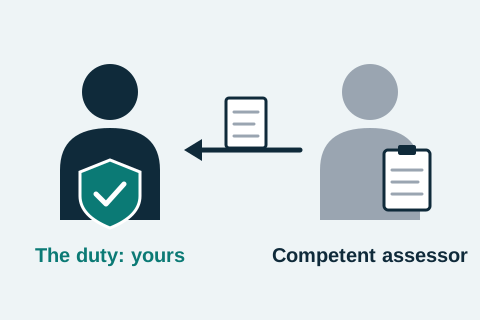
The assessment is your responsibility as the employer or the person in control of the premises. The HSE says it should be done by someone competent: with the training, experience and knowledge. For most commercial and industrial buildings that means a professional assessor.
Ask any assessor what they are qualified in, whether they are registered with the Legionella Control Association, and for a sample report. Bringing in a contractor does not move the duty: it stays with you, and so does checking that the work is done to the standard you need.
The report changes hands. The duty does not.
Quick question
When it is reviewed
Regularly, and at once when there is reason to think it no longer holds. The HSE lists the reasons.
The HSE’s words · 1 of 2
Review the assessment regularly, and at once if there is reason to think it no longer holds: the system or the building's use has changed, new information has come to light, the checks show a control is not working, or someone has fallen ill.
There is no fixed interval in law. The old habit of 'every two years' is not a rule: the trigger is any reason to think the assessment no longer holds.
Reading it, and the written scheme that follows
Start with the significant findings: the risks the assessor found, each with a priority. Those become actions with an owner and a date. Then read the schematic until you can point to every part of it in the building.
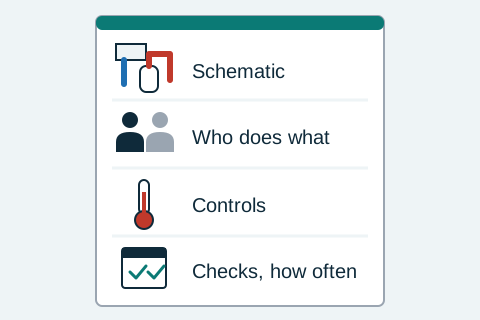
The written scheme turns the assessment into a routine: the schematic, who is responsible for what, how the system is run safely, the controls, and which checks are made and how often. The responsible person needs the authority to make it happen, as well as the knowledge.
The written scheme: the assessment turned into a routine.
Quick question
In your building
For something else, or i just want to understand it.
Find the assessment and the written scheme. If there is neither, that is where you start. If there is an assessment but no scheme, the findings have never been turned into a routine, and that is the next step.
This week: find the assessment and the scheme, and the name of the responsible person.
In short
The assessment names the responsible person, describes the system with a schematic, lists the risks and controls, sets the checks and says when it is reviewed.
It is your responsibility; a competent person does it, for most buildings a professional assessor, and the duty stays with you.
Review it regularly and at once when anything changes; there is no two-year rule.
The written scheme turns the findings into a routine: who does what, which checks, how often.
Before you go · question 1 of 3 · not marked
Module 5 of 8 done
Next: Module 6, Keeping the water hot, cold or treated.