Welcome. This is our free legionella awareness course for the people who look after a building's water. A minute on how it works, then module 1.
Eight short modules, about eight minutes each.
A tutor, if you press Read to me, and a question every few minutes.
The HSE's own words behind every rule.
Your building: the examples fit where you work.
A test and a certificate once the eight are done.
Your place is saved as you go. Sign in to keep it on every device.
In this module
By the end you will be able to:
Say what legionella is and how people catch it
Name who is most at risk
Spot the four conditions that let it grow
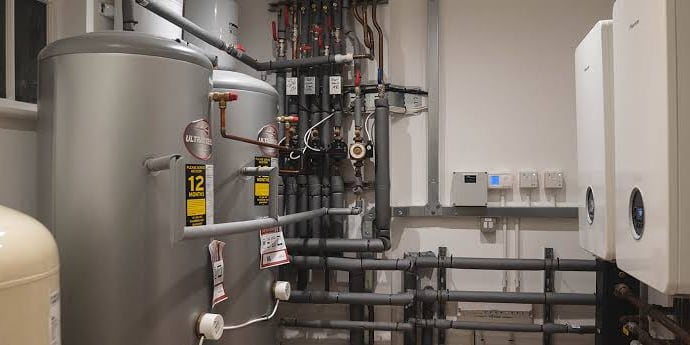
A plant room like thousands across the UK.
Nothing here looks dangerous. What would worry a legionella assessor?
What an assessor sees
Warm standing water. The cylinder's base, a pipe to a tap nobody uses, a tank that gets warm in summer. None of it looks like a hazard, which is the point of this course.
A bacterium that lives in water
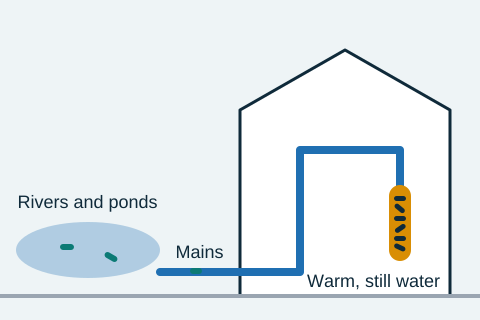
Legionella is a bacterium found naturally in rivers and ponds, in numbers too small to matter. It arrives in your building through the mains supply, harmless.
The trouble starts inside the building. Where water sits warm and still, the numbers climb. The HSE puts it this way: outbreaks come from "purpose-built systems where water is maintained at a temperature high enough to encourage growth".
A few in the mains; many where water sits warm and still.
The illness, and how it is caught
Legionnaires' disease is a potentially fatal pneumonia. It starts like flu: a high temperature, chills, a cough, aching muscles, a headache. It can move on to pneumonia, diarrhoea and confusion.
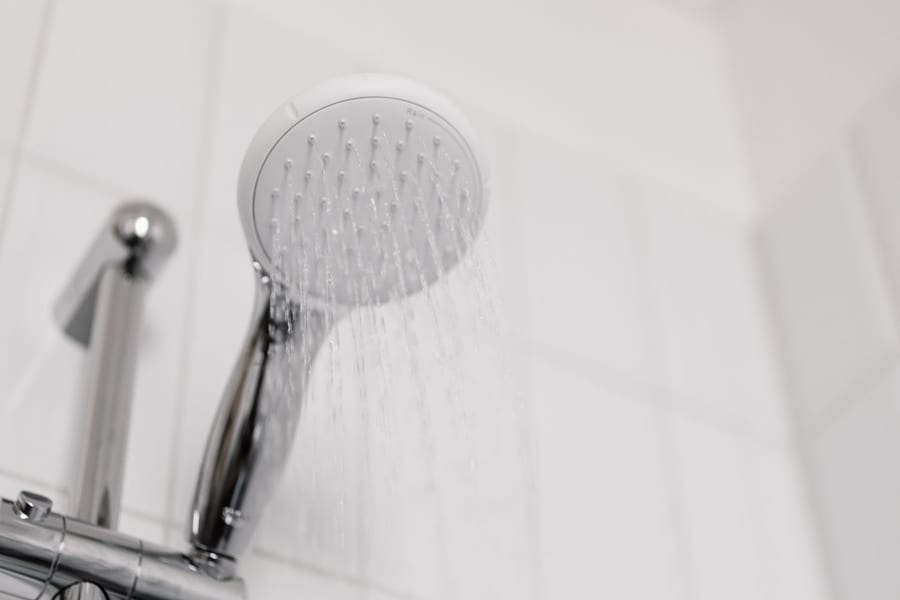
People catch it by breathing in tiny droplets of water that carry the bacteria. Not usually by drinking it, and not from each other: the HSE says it is not known to spread from person to person.
Caught by breathing in spray, not usually by drinking.
Quick question
What the HSE says raises the risk
Four conditions. Every check in this course comes back to one of them.
Four things raise the risk: water between 20 and 45 °C; a way of making breathable droplets; water that is stored or goes round again; and deposits that feed the bacteria, such as rust, sludge, scale and biofilm.
Who is most at risk
Everyone can catch it. The HSE names the people at higher risk: over 45, smokers and heavy drinkers, people with long-term chest or kidney disease, diabetes, lung or heart disease, and anyone whose immune system is weakened.
That is why the same water system carries more risk in a care home or a hospital than in a warehouse, and why your assessment asks who uses the building.
Quick question
In your building
For something else, or i just want to understand it.
Wherever people breathe in spray from water that has stood warm, the risk is there: showers first, then sprays, hoses, fountains and humidifiers, and any tap at the end of a pipe nobody uses.
This week: list every outlet in your building that is not used every day.
In short
Legionella is caught by breathing in droplets, not usually by drinking, and not from other people.
It grows when water sits between 20 °C and 45 °C.
Four conditions raise the risk: warmth, spray, stored or recirculated water, and deposits that feed it.
Everyone can catch it; older, unwell and immune-weakened people most easily.
Before you go · question 1 of 3 · not marked
Module 1 of 8 done
Next: Module 2, Your legal duties, and who is responsible.