Keeping the water hot, cold or treated
Module 6 of 8 · about 8 minutes
Module 6 of 8 · sScreen 1 of 12 · about 8 minutes
In this module
By the end you will be able to:
- State the three temperatures and say why each one matters
- Explain how a system keeps them, and where it tends to fail
- Know what chemical and other treatments do, and what they never replace
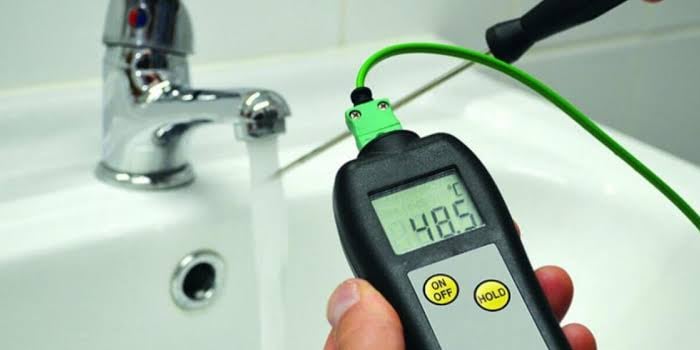
After a full minute this hot tap reads 48.5 °C. Pass or fail?
What an assessor sees
Fail. The HSE's figure is 50 °C within one minute at the outlet (55 °C in healthcare). Reaching only 48.5 °C means the system is not holding its temperature, and water standing further back in that branch between uses will be cooler, down in the band where legionella grows. The question for the responsible person is why: a long branch, a failed pump, a cylinder set too low, or a mixing valve upstream.
Temperature is the first control
Legionella multiplies between 20 and 45 °C. So the rules are three numbers that keep water out of that band: hot water stored at 60 °C or more; 50 °C at every hot tap within a minute (55 °C in healthcare); cold water below 20 °C within two minutes.
Everything else in this module exists to hold those numbers in every part of the system, all year, including the far ends and the quiet corners.
Keeping it that way
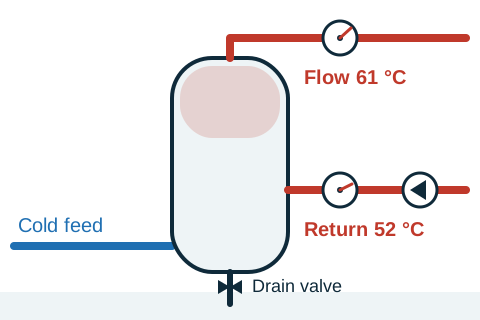
Hot: the calorifier's flow is checked at 60 °C and its return at not less than 50 °C, every month. Pipes are insulated, branches kept short, and the pump that drives the loop is a legionella control, not just a comfort.
Cold: tanks lidded, insulated and away from heat; cold pipes kept apart from hot ones; stored volume no bigger than a day's use. Mixing valves sit as close to the outlet as possible, so the lukewarm pipe after them is short, and are serviced on the maker's schedule.
Quick question
The temperatures, in the HSE's words
The HSE’s words · 1 of 4
Temperature is the first and usual control: cold kept cold, hot kept hot, so the bacteria never get the warmth they need.
Hot water is stored at 60 °C or more and reaches 50 °C at the tap within one minute (55 °C in healthcare).
Cold water is kept below 20 °C, and should be there within two minutes of running the tap.
Every month, the water leaving the calorifier is checked at 60 °C or more, and the water coming back round the loop at not less than 50 °C.
When temperature is not enough: treatment
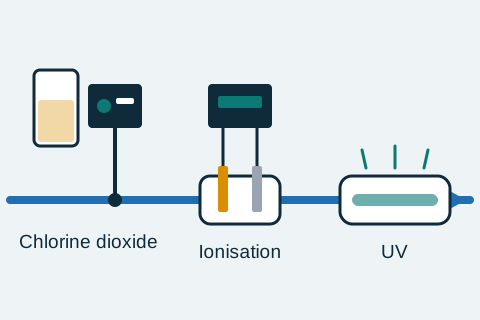
Some systems cannot hold the temperatures everywhere: very large buildings, hospitals, old pipework. Then a treatment is added. Chlorine dioxide is dosed into the water and measured monthly at the sentinel taps (the nearest and furthest taps), at least 0.1 mg/l (milligrams in each litre). Copper and silver ionisation releases ions that kill bacteria. Ultraviolet light treats water passing a lamp, and works only very close to it.
A treatment is run by a specialist, checked and logged like any other control, and never excuses the basics. A dosed system still needs its dead legs removed, its outlets flushed and its tanks clean.
Quick question
In your building
For something else, or i just want to understand it.
Find out what keeps your hot water hot and your cold water cold, and who checks it. If the building has a dosing unit or an ionisation system, find out who services it and where the monthly readings are written.
This week: find the calorifier or boiler and read what temperature it is set to.
In short
- Three numbers: hot stored at 60 °C, 50 °C at the tap within a minute (55 in healthcare), cold below 20 °C within two minutes.
- The calorifier's flow and return are checked monthly; pipes insulated, branches short, tanks cool and lidded, mixing valves close to the outlet.
- Chlorine dioxide, copper and silver ionisation and UV are added where temperature cannot be held, and never replace flushing, cleaning and removing dead legs.
Before you go · question 1 of 3 · not marked
Module 6 of 8 done
Next: Module 7, The routine checks and the log book.
Save and carry on later: this browser remembers where you are.
Sources
Words last checked 17 October 2026. Spotted a mistake? Tell us. Course version 2026.10.