Say why a care setting is treated as high risk, and what that changes
State the healthcare temperature and the action on any legionella found
Balance the two risks at every outlet: legionella and scalding
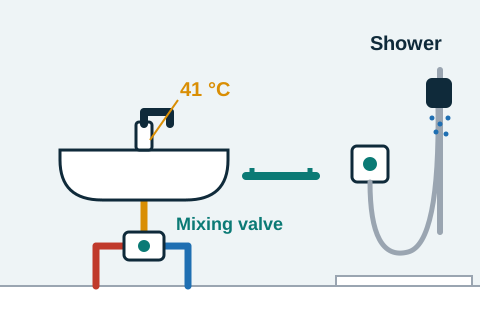
One en-suite, two risks.
The water at this resident's basin is set to 41 °C so nobody is scalded. What has that done to the legionella risk?
What an assessor sees
Moved it to the pipe after the mixing valve, which now holds water at exactly the temperature legionella likes. That is the care-home balance in one fitting: hot enough behind the valve to keep legionella from growing, cool enough after it not to burn, and the lukewarm stretch kept as short as possible and flushed.
Why high risk changes the rules
The HSE names healthcare premises, care homes and residential homes as high risk locations: the people exposed are older, ill, or both, and far more likely to be infected and to die of it. The same bacteria in the same pipe is a bigger risk here than in an office.
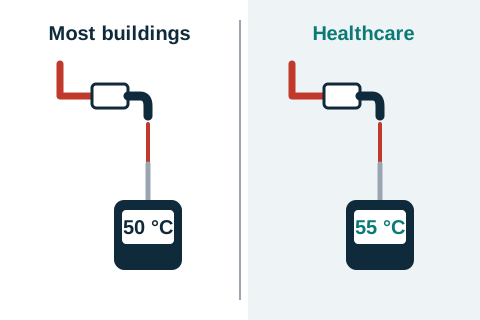
How much of the HSE's healthcare guidance applies depends on how vulnerable your residents are, and your risk assessment says which parts. Where it applies, hot water reaches 55 °C at the tap, not 50; any legionella found is investigated, not just counts over 100; and sampling programmes, rare elsewhere, are usual.
Same pipework, same bacteria, a higher figure.
Scalding and mixing valves
Above 44 °C water scalds, and the very young, the elderly and people who cannot feel or react to heat are the ones burned. So where vulnerable residents use baths and showers, a Type 3 thermostatic mixing valve is required, serviced and fail-safe. At basins, the valve's scald protection is weighed against the lukewarm stretch it adds, and your risk assessment decides.
The valve creates the lukewarm stretch. It is kept short, flushed, and its outlets are the ones whose checks matter most. Healthcare is also advised against EPDM-lined flexible hoses (braided hoses lined with a synthetic rubber) under basins: they grow biofilm. Care homes do well to follow.
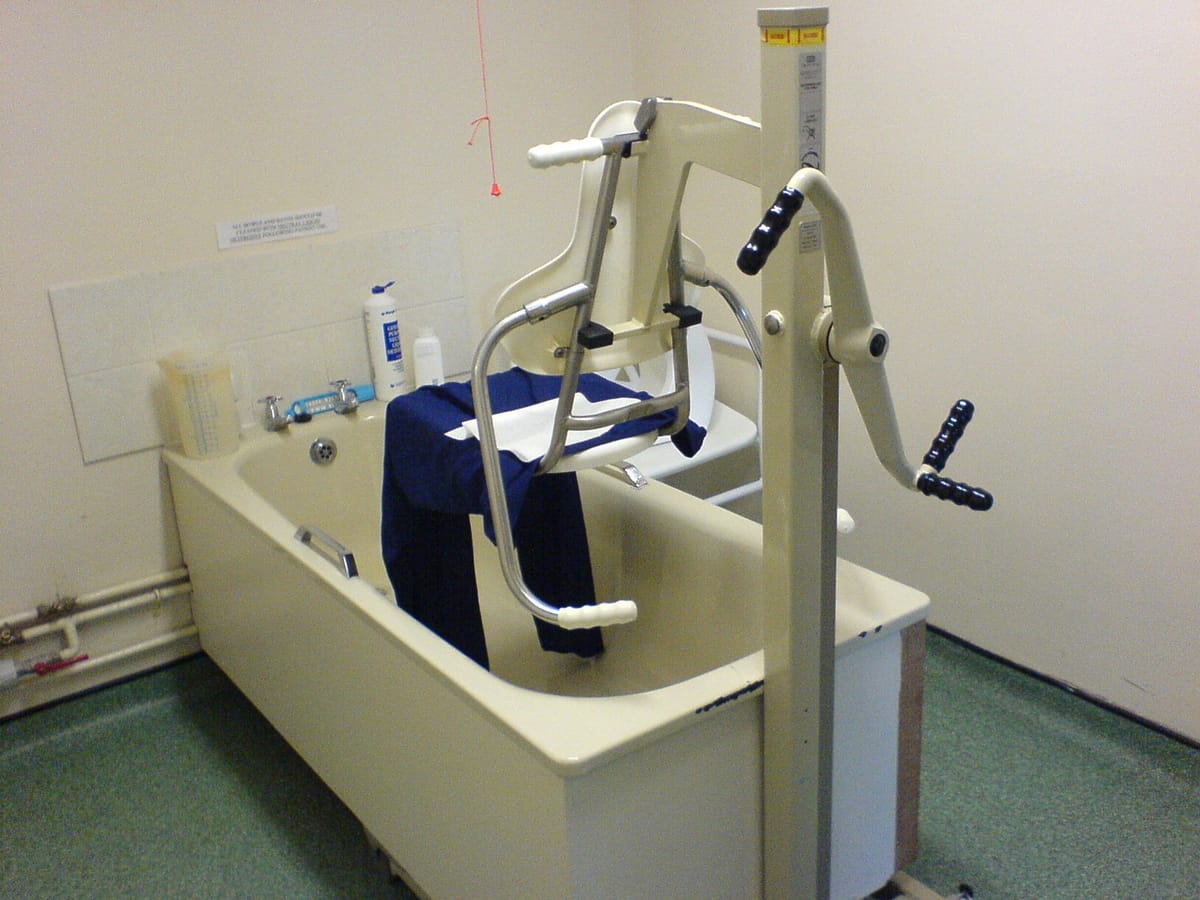
An assisted bath with a hoist. Photo: Rwendland, CC BY-SA 4.0.
Quick question
The stricter rules, in the HSE's words
The HSE’s words · 1 of 4
Water systems in healthcare premises, care homes and residential homes need particular care, because the people using them are more likely to be infected.
Hot water is stored at 60 °C or more and reaches 50 °C at the tap within one minute (55 °C in healthcare).
In healthcare, any legionella found at all is investigated, and the system resampled if need be, because the first concern is protecting susceptible patients.
Water above 44 °C at an outlet can scald, and the danger is greatest where vulnerable people, the very young and the elderly among them, bathe or shower.
HTM 04-01, and what a care home borrows from it
Hospitals work to Health Technical Memorandum 04-01, the NHS's own water safety framework: a water safety group, a water safety plan, named roles, and routines by ward. The HSE points healthcare premises to it.
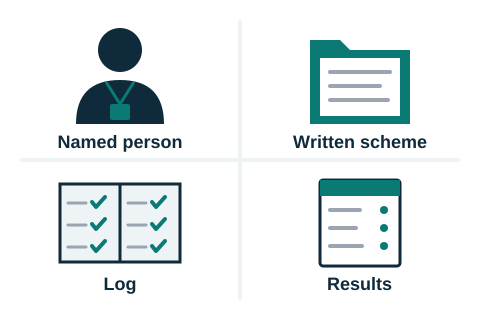
A care home is not a hospital, but regulators and commissioners expect the same shape in miniature: a named responsible person, a written scheme, empty rooms flushed and logged, valves serviced, results kept with the log, and any detection acted on. Your assessor should write the scheme with that in mind.
The hospital framework, in miniature.
Quick question
In your building
For something else, or i just want to understand it.
If older, ill or vulnerable people use your water, ask your assessor how much of the healthcare guidance applies: it may mean 55 °C at the tap, mixing valves serviced, empty rooms flushed more often, and any legionella found investigated. If they do not, the core course's rules stand.
This week: decide whether your users make the building high risk, and write the answer in the scheme.
In short
Healthcare premises, care homes and residential homes are high-risk locations: the same bacteria is a bigger risk, so the rules tighten.
55 °C at the tap, any legionella found investigated, sampling usual; mixing valves on the baths and showers residents use, serviced, with the lukewarm stretch kept short and flushed; no EPDM hoses.
HTM 04-01 is the hospital framework; a care home borrows its shape: a named person, a scheme, flushing logged, valves serviced, results with the log.
Before you go · question 1 of 3 · not marked
Module C done
That is this extra done; it is named on your certificate. The course page has the others.