Recognise a cooling tower or evaporative condenser, and say why it is the highest-risk system there is
State the duty to notify the council, and when
Know the routine: weekly dip slides, quarterly legionella samples, cleaning once or twice a year depending on the system, every three months where it is dirty
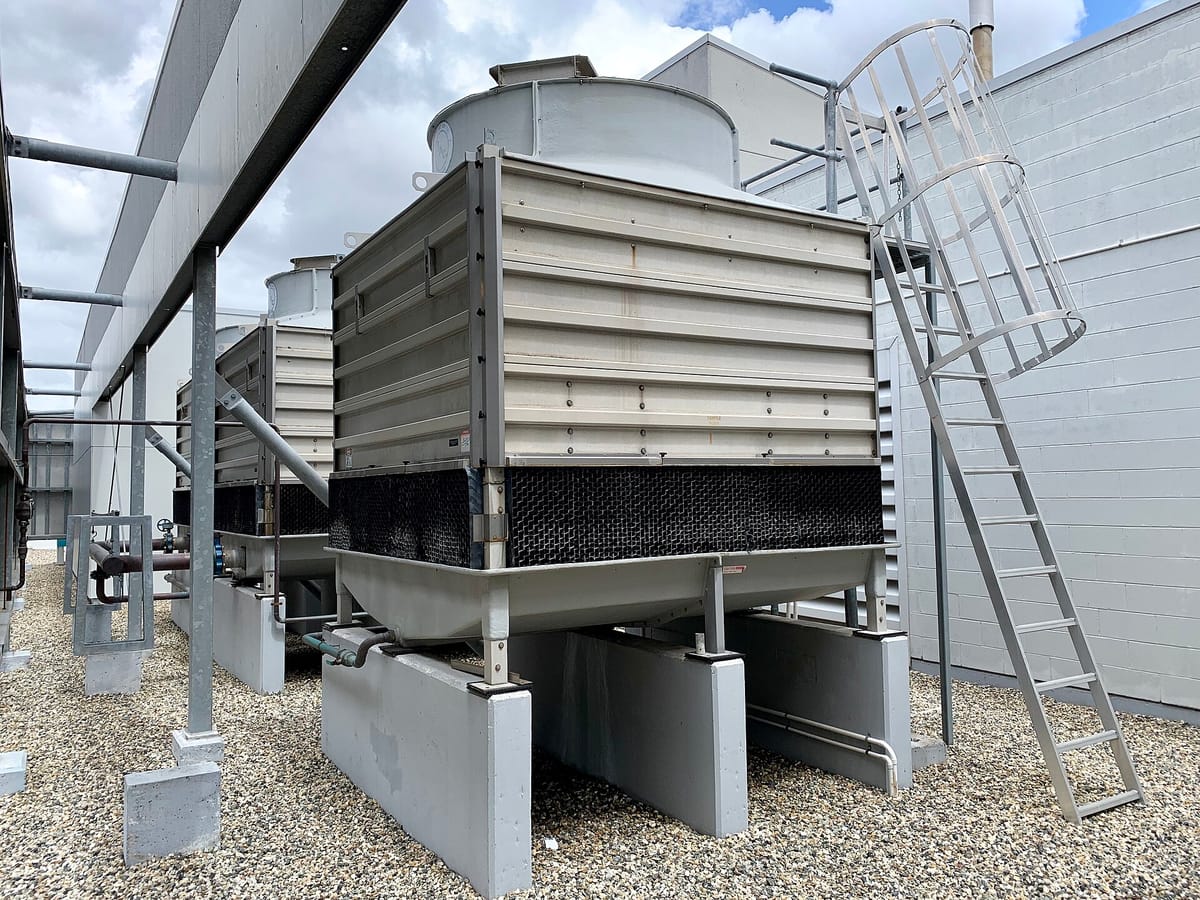
Cooling towers on an office roof. Photo: Chris Olszewski, CC BY-SA 4.0.
When these towers run, they give off a plume that can drift well beyond the building. What is in it?
What an assessor sees
Tiny droplets of the tower's water, thrown off as it cools. If legionella is growing in the tower's warm pond, the droplets carry it over the street, the car park and the next building. That is how the big outbreaks happened: Barrow-in-Furness in 2002, south-west Edinburgh in 2012, people who never set foot in the building.
What it is
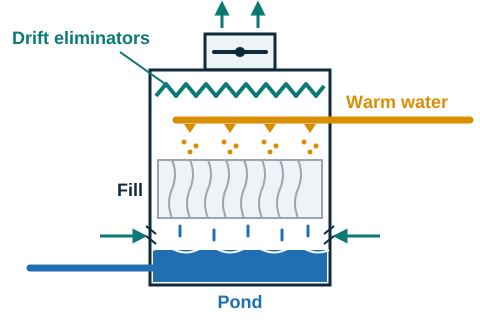
A cooling tower cools water by letting some of it evaporate: warm water is sprayed over a fill pack, a fan draws air through, and the cooled water collects in a pond below to go round again. An evaporative condenser does the same job around refrigeration coils.
Warm water, recirculated, open to the air, with a fan making droplets: all four conditions in one machine, which is why the law treats it differently from every other system. Dry coolers that spray no water are a different thing.
Sprayed down, air up, collected in the pond, round again.
The duty to notify
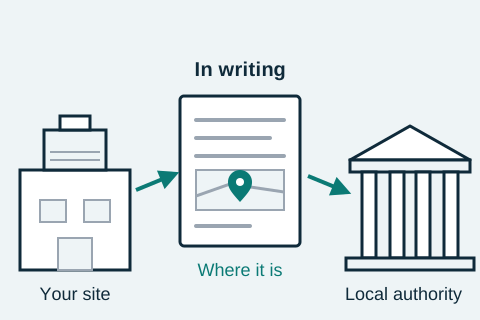
If you operate a cooling tower or evaporative condenser you must notify the local authority in writing, saying where it is, under the 1992 Notification Regulations, and tell them again when it goes out of use. Forms come from environmental health.
The register is what the public health teams turn to first in an outbreak. A tower that is not on it is a tower nobody knows to check. Drift eliminators on the tower, kept in good order, are what hold most of the droplets back.
A letter to the council, saying where the tower is.
Quick question
The routine, in the HSE's words
A tower is run with a water treatment specialist, but the responsible person owns the routine and reads the results.
The HSE’s words · 1 of 4
The biocide treatment is checked weekly with dip slides, and the water is sampled for legionella at least every three months.
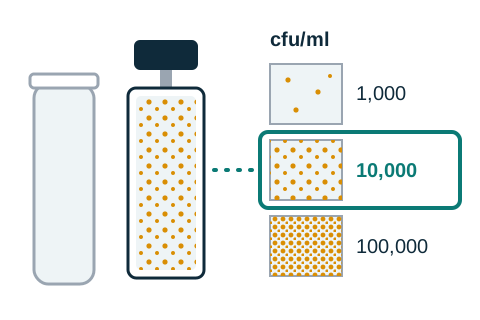
A cooling system under control shows no more than 10,000 cfu/ml on a dip slide, and legionella not detected or no more than 100 cfu/l.
A tower is cleaned and disinfected at least every three months in a dirty environment, at least twice a year for comfort cooling, and at least once a year for a clean industrial system.
The 1992 Regulations make an employer notify the local authority in writing of any cooling tower or evaporative condenser it operates, where it is, and when it goes out of use.
Reading the numbers, and restarting a tower
Dip slides are read against three bands: up to 10,000 cfu/ml is under control; up to 100,000 means review the treatment, adjust the biocide (the chemical that keeps bacteria down) and resample in 24 hours; above that, act. Legionella should be not detected, or no more than 100 cfu/l. The dip slide counts all bacteria per millilitre; the lab test, on a separate sample, counts only legionella per litre.
A tower that has stood idle for a month or more, or any system whose use has changed, is inspected and disinfected, and cleaned if needed, before it runs again. Your risk assessment may call for this sooner in summer, and in healthcare after more than five days.
A dip slide read against the chart.
Quick question
In your building
For something else, or i just want to understand it.
Find out whether your building, or one near it, has a cooling tower or evaporative condenser. If it does, the three questions are: is it notified, who runs the treatment, and when was it last cleaned.
This week: find out whether a tower is anywhere near, and whether it is on the register.
In short
A cooling tower cools water by evaporation and throws droplets into the air: the highest-risk system, and the one behind the largest outbreaks.
Notify the council in writing, and again when it stops; keep the drift eliminators in good order.
Weekly dip slides (under 10,000 cfu/ml), quarterly legionella samples (not detected or under 100 cfu/l), cleaning at least twice a year for air conditioning, every three months in a dirty environment, yearly for a clean industrial system, and a disinfection, with a clean if needed, before any restart after a month idle.
Before you go · question 1 of 3 · not marked
Module A done
That is this extra done; it is named on your certificate. The course page has the others.